Music That Listens
The Student Handbook · Volume One of the Music That Listens series
By Ted Kocher
For the editors, designers, and implementers figuring it out in the room.
© 2026 Ted Kocher. All rights reserved.
Foreword
Game music is the only music that listens back.
A film cue plays the same way every time. A game score watches the player, waits, and answers — and that behavior does not compose itself. Between the music and the shipped game sits a craft with no university degree, and this book teaches it: what a musical system is, how loops, moods, chunks, and layers think, and how a design becomes something a game can run. Everything in it can be designed, heard, and shared from a web browser, on the canvas this book was written alongside: ScoreCanvas (scorecanvas.io).
The book reads at three depths, and you choose. STUDENT is the book itself — every idea, in plain language, free. PRO folds in the working habits of people doing this daily. EXPERT goes to the deep end: the editorial and pipeline craft, preserved in detail. Each chapter ends with a short check — answer it right in the book — and the checks are the first mile of the instructor certification path. Chapters that have a playable companion lesson in the app say so, right at the top.
About This Book
Nine chapters: how game music gets made, why designing comes before implementing, the vocabulary, and the four great machines — the loop package, the mood pool, the interactive package, the chunk system, the layered system — ending with the handoff that carries a design into a game engine, and a note on why this book exists.
The Music That Listens Series
Volume One — The Student Handbook. The Art and Systems of Game Music Design. The ideas: why game music listens, how adaptive systems are designed, and how a design becomes a shipped behavior. Everything in it can be done in a browser.
Volume Two — The Technical Manual. What You Actually Need to Start. Five real steps — assets, systems, never losing anything, infrastructure, session preparation — written so anyone can read them, with PRO and EXPERT layers that go exactly as deep as the reader does. The deep layer preserves the manual art of music editorial, on purpose, before it's gone.
Volume Three — The Teacher's Manual. Courses, Rubrics, and the Instructor's Craft. Three complete course formats — a one-day workshop, a seven-week intensive, and a fifteen-week semester — with the workbook, rubrics, and everything a non-author instructor needs to teach them.
Table of Contents
- Chapter 1: How Game Music Gets Made
- Chapter 2: Designing Before Implementing
- Chapter 3: The Words
- Chapter 4: Intros, Loops, and Endtags
- Chapter 5: Moods & Atmospheric Systems
- Chapter 6: Interactive Music Packages
- Chapter 7: Chunk-Based Systems
- Chapter 8: Layered Systems
- Chapter 9: The Handoff
- A Final Note: Why This Book Exists
Chapter 1How Game Music Gets Made
Game music is the only music that listens back. A film score plays the same way every night. A game score watches the player, waits, and answers — it holds its breath while you explore, and detonates the moment the world does. It sounds composed for exactly what just happened, even though nobody could have known what would happen until it did.
That behavior does not compose itself. Between someone writing music and a game playing it sits a craft — part design, part translation — and this book teaches it. Here is the whole journey in one paragraph:
Music gets written and produced, usually on a computer, as a mockup — a full-sounding recording made with software instruments, sometimes sweetened with real players. The music then gets taken apart into stems — its separated layers — because a game doesn't play a recording, it plays parts. Someone designs the system: the rules for which parts play when, how the music enters, repeats, changes, and ends as the player acts. And then that design gets built into the game and tested against the only critic that matters: someone actually playing.
Made twice, in other words. Once as music. Once as behavior. This book is about the second making — and everything in it can be designed, heard, and shared from a web browser.
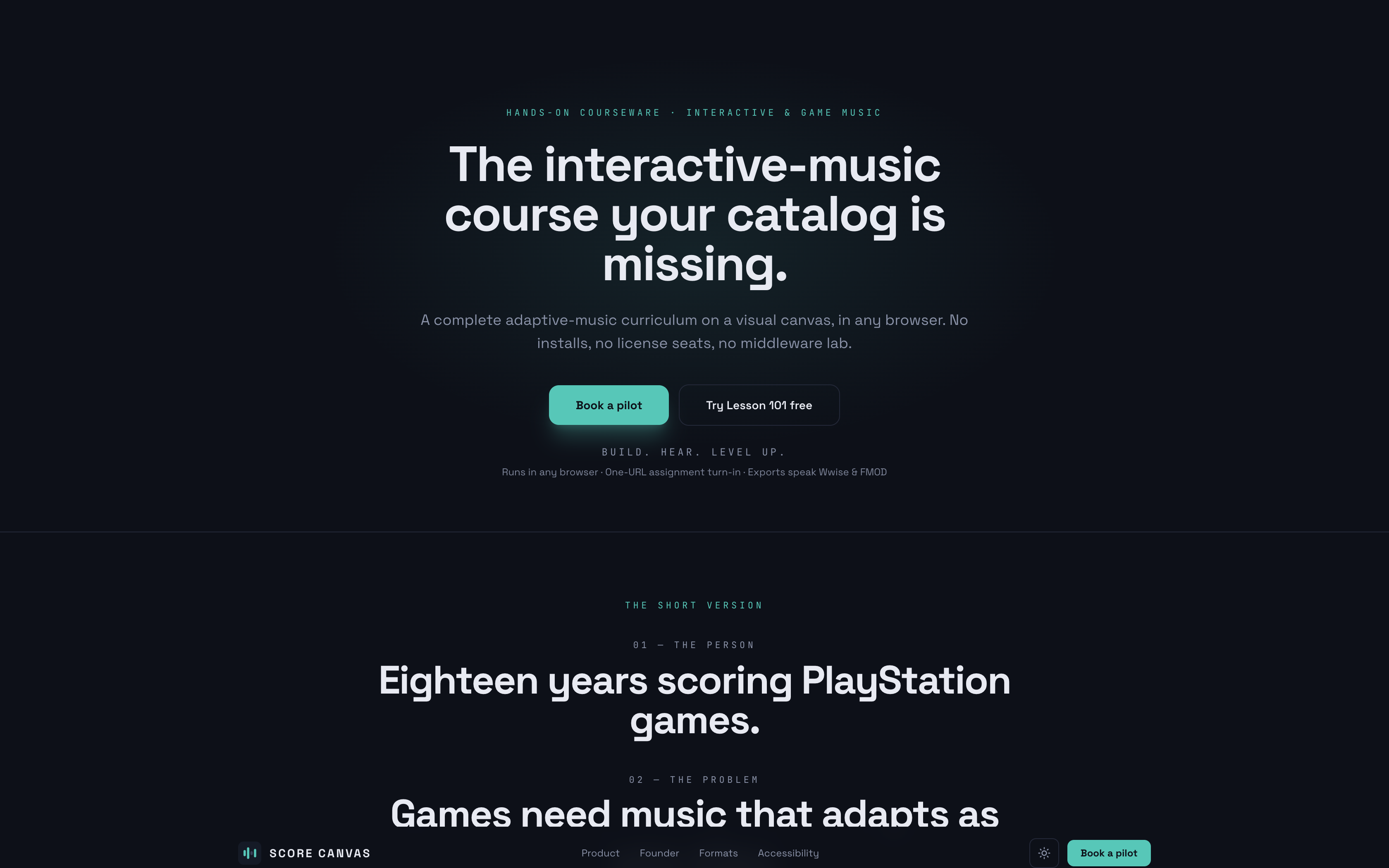
The idea: game music is made twice — once as music, once as behavior — and the second making is a craft you can learn.
Chapter 2Designing Before Implementing
Every other discipline in game development has something to look at. Concept art can be pinned to a wall. A level can be walked through. A script can be read aloud. For most of its history, interactive music had nothing — a musical system existed only as a description, a document saying "the combat music should intensify as enemies approach," and then, months later, as finished code in a game engine. Between those two points: pure faith.
Descriptions of music behavior fail for a simple reason: nobody can hear a document. The creative director approves words, the implementer builds their interpretation of the words, and everyone discovers at the end whether those were the same piece of music. Often they were not, and the discovery costs a milestone.
The fix is an old idea from every other design field: make the thing auditionable before you build it. Design the system on a canvas where it actually plays — where the loop loops, the transition transitions, and the intensity rises when you drag the slider. Let everyone hear it behave. Argue about it while arguing is cheap. Then export the spec — the precise description generated from the behaving design — and hand that to implementation.
Design → audition → spec → implement. In that order, always. This book teaches every system shape in that method, and the canvas at scorecanvas.io is where the designing happens.
The idea: never describe a musical behavior you could instead let someone hear.
Chapter 3The Words
Every craft has its words, and this one has fewer than you'd fear. Ten get you through the whole book:
A cue is one piece of music written for the game — the combat piece, the village piece. A stem is one separated layer of a cue — the drums alone, the strings alone. A loop is music built to repeat without you noticing where it repeats. An intro is the entrance — the music that plays once, before the loop takes over. An endtag is the exit — the short ending that lets music finish instead of stopping. A stinger is a musical exclamation point played over whatever else is happening — the treasure-found flourish. A transition is how music gets from one piece to another without embarrassing itself. A state is a situation the game can be in that music cares about: exploring, combat, victory. A mood is a pool of interchangeable atmospheric pieces the game can draw from. A layer is one strand of a stack of music that can build and thin as things change.
That's the vocabulary. Everything else in this book is arrangements of those ten ideas.
The idea: ten words carry the craft — learn them as things music does, not definitions to memorize.
Chapter 4Intros, Loops, and Endtags
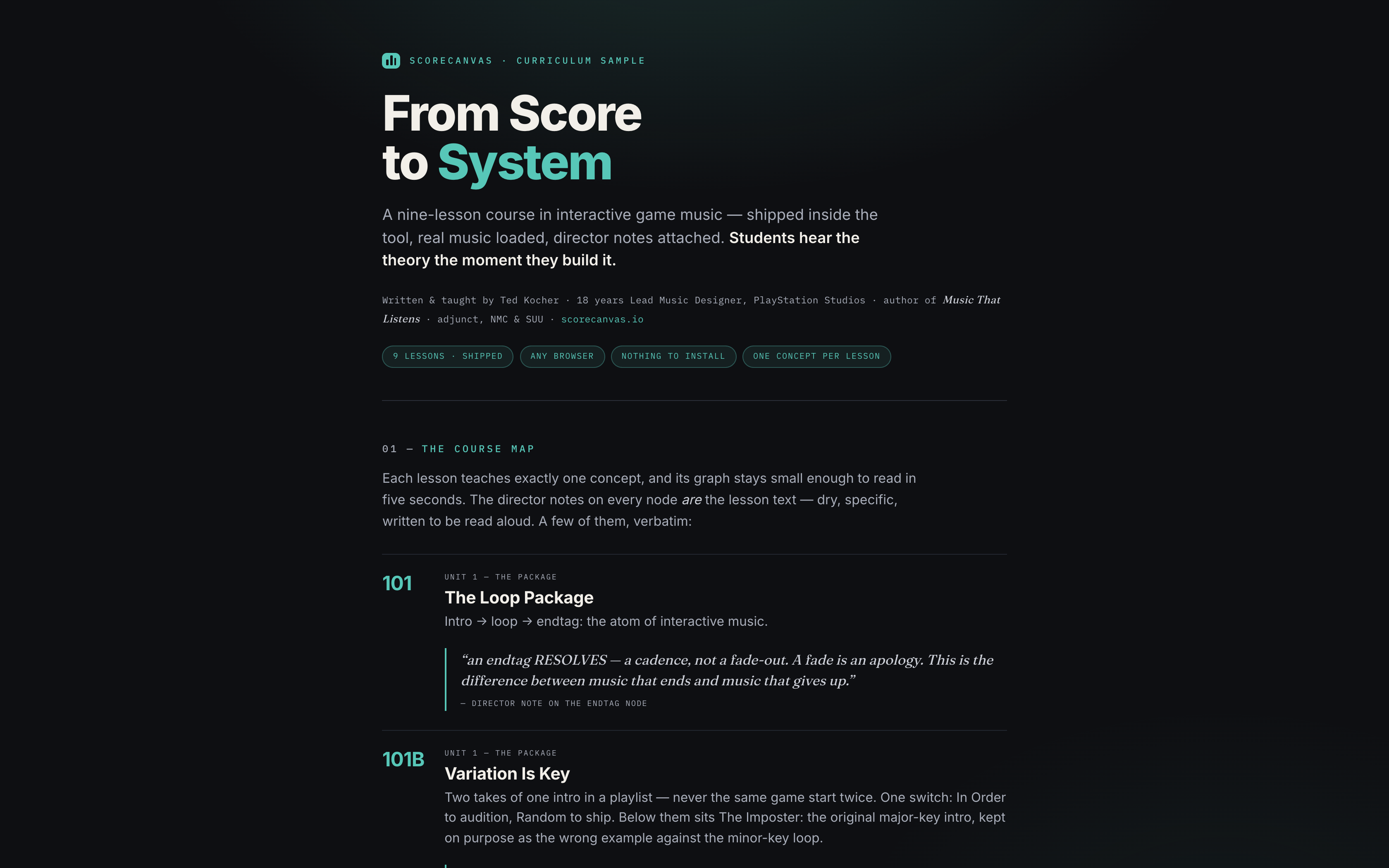
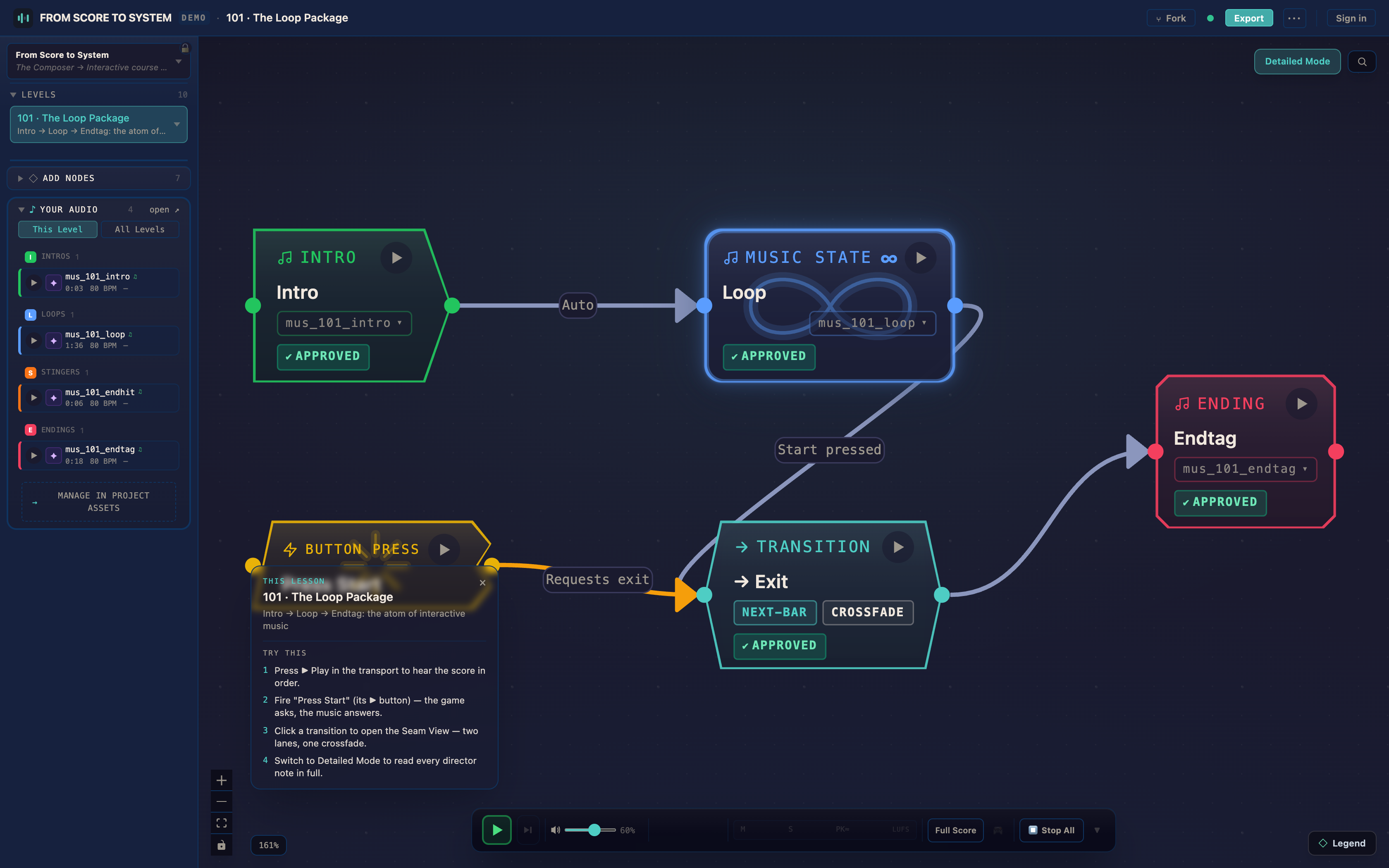
▶ Build your first loop package in Lesson 101.Here is the first machine of game music, and the most important one: the loop package. Three parts. An intro that plays once — the entrance, the statement, the fireworks. A loop that repeats for as long as the player needs it to — a minute, an hour, nobody knows. And an endtag that plays once at the exit, so the music gets to finish instead of being switched off.
Intro, loop, endtag. Enter like music, stay like weather, leave like music.
The deep craft is in the loop, and it obeys one brutal rule: the hundredth repetition must be as listenable as the first. That rule makes the writing counterintuitive. The loop point — the seam where the end rejoins the beginning — should be the least eventful moment in the piece, because anything memorable at the seam gets memorized by the player's ear after three passes and turns into a skipping record. The big memorable idea belongs in the intro and the endtag — the parts that play once. Inside the loop, variation lives in the landscape: voicings shift, a countermelody surfaces on alternate passes, the interest is distributed instead of spiked.
The idea: enter once, hold forever, exit like music — and keep the seam boring.
Chapter 5Moods & Atmospheric Systems
Not all game music is an event. Most hours of most games are atmosphere — the long quiet middle where the player is walking, reading, building, thinking — and the worst thing music can do there is demand attention. The machine for this is the mood: not one piece of music, but a pool of interchangeable pieces that share a world — same palette, same temperature, no urgency — that the game draws from, shuffles, and spaces out over time.
The pool is the point. One atmospheric piece, however beautiful, becomes wallpaper with a pattern — the ear finds the repeat and starts waiting for it. Five pieces that agree with each other, played in varying order with air between them, become a place. And the air is not a gap: silence is a member of every mood pool, the one track that never wears out.
The idea: atmosphere is a pool, not a piece — and silence is in the pool.
Chapter 6Interactive Music Packages
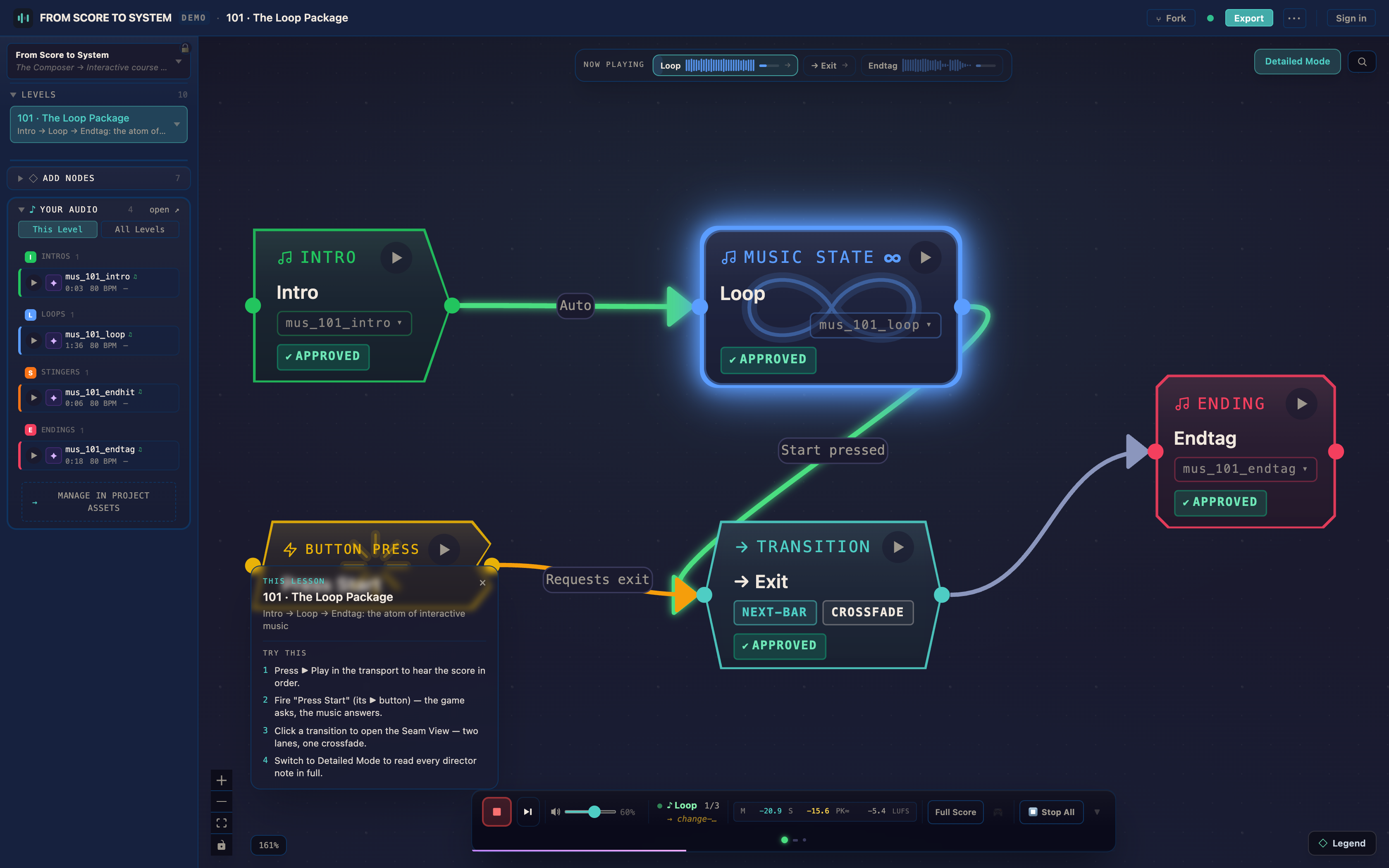
▶ Wire your first transition in Lesson 102 — then states and stingers in 103 and 104.Now the machines connect. A game has situations — exploring, danger, combat, victory — and the music for each is its own loop package. The interactive music package is the machine of machines: the map of states, the packages inside them, and the transitions that carry the player's ear from one to the next.
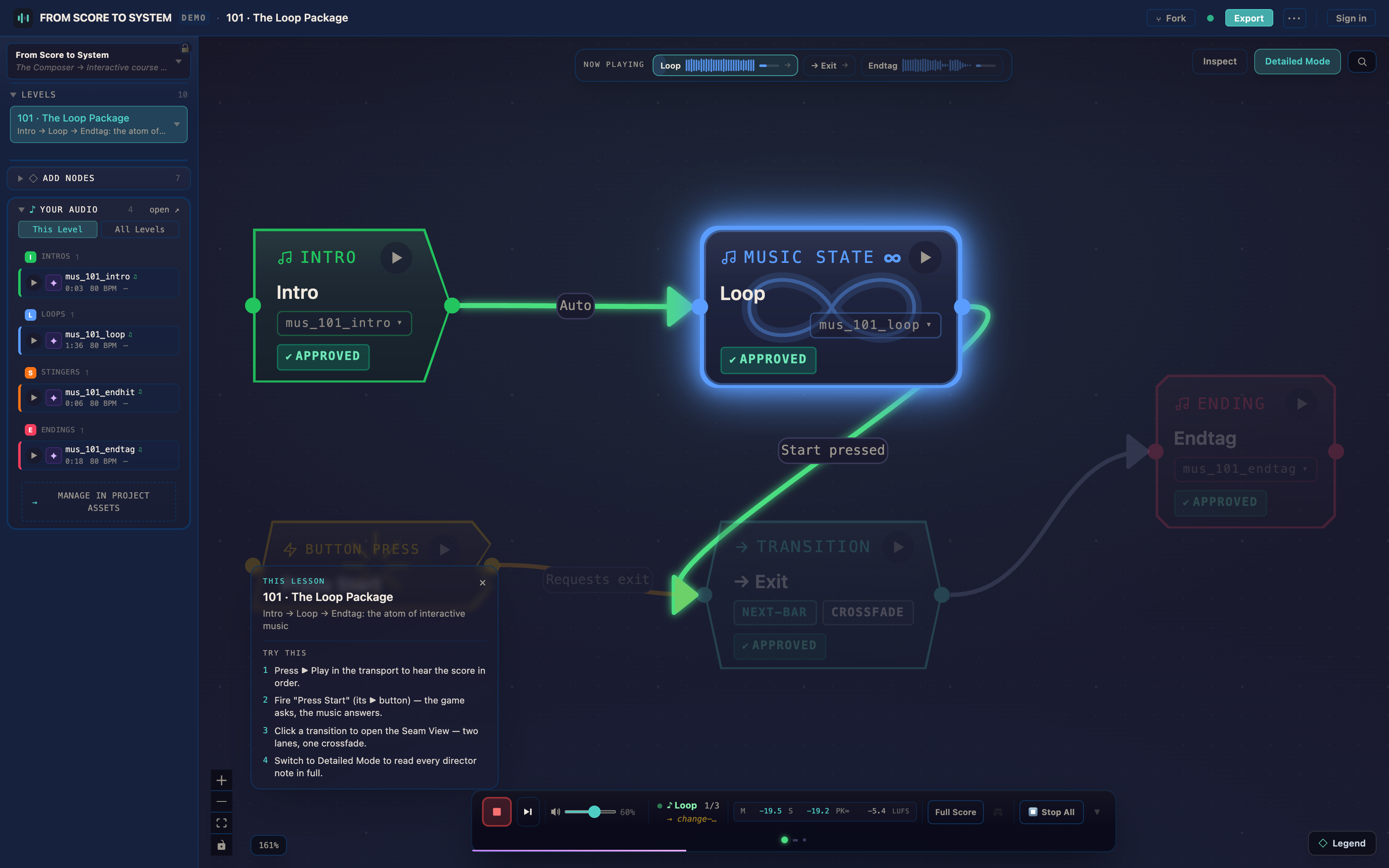
The transition is where interactive music is won or lost. A player leaves exploration for combat in half a second; the music has to follow without sounding like someone changed the radio station. Every transition is four decisions: when to move (immediately? at the next bar line?), how to leave (cut, fade, or let a phrase finish?), how to arrive (from the top? from an entry point that fits the moment?), and what covers the seam (nothing? a stinger flourish that makes the joint sound intentional?).
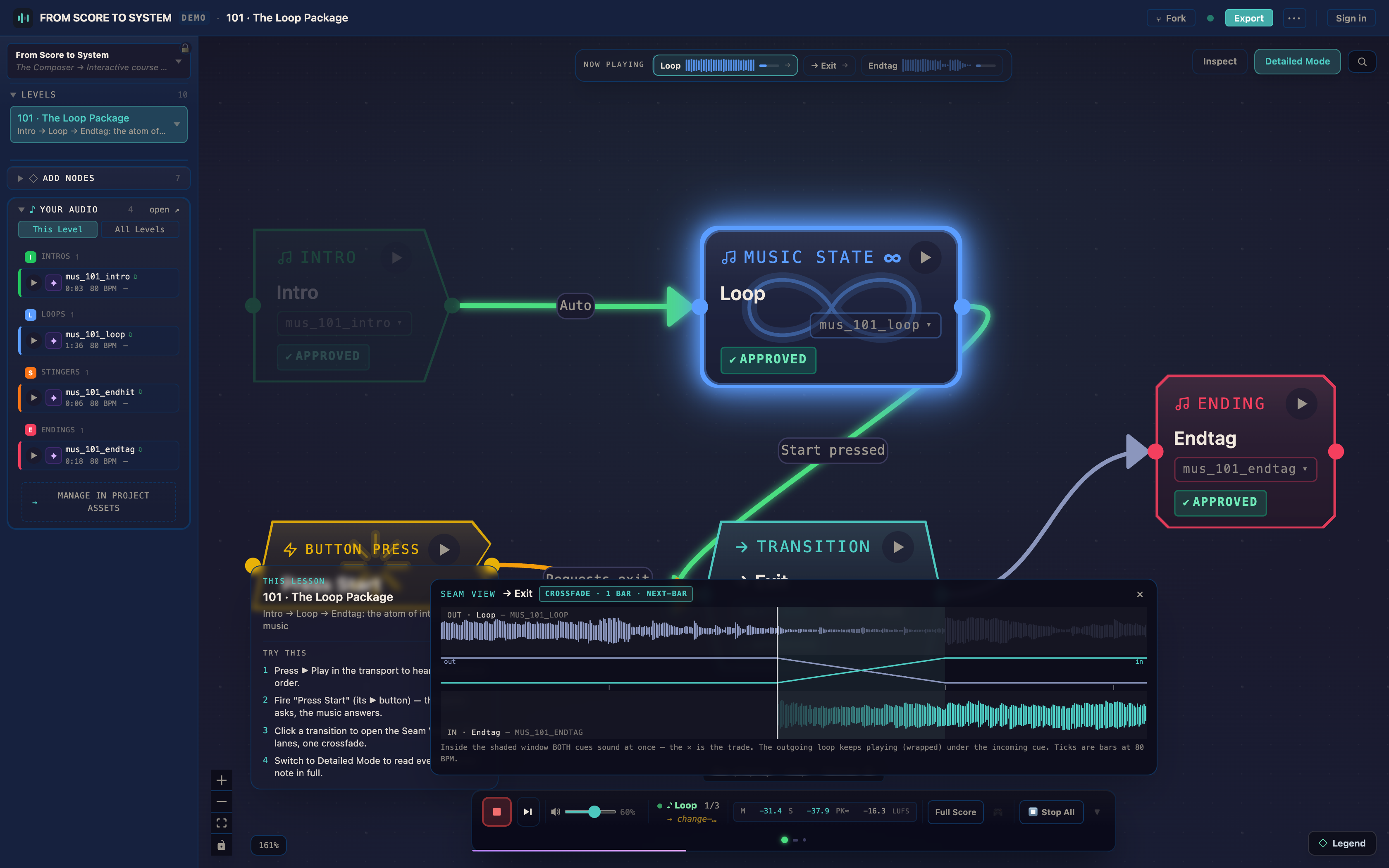
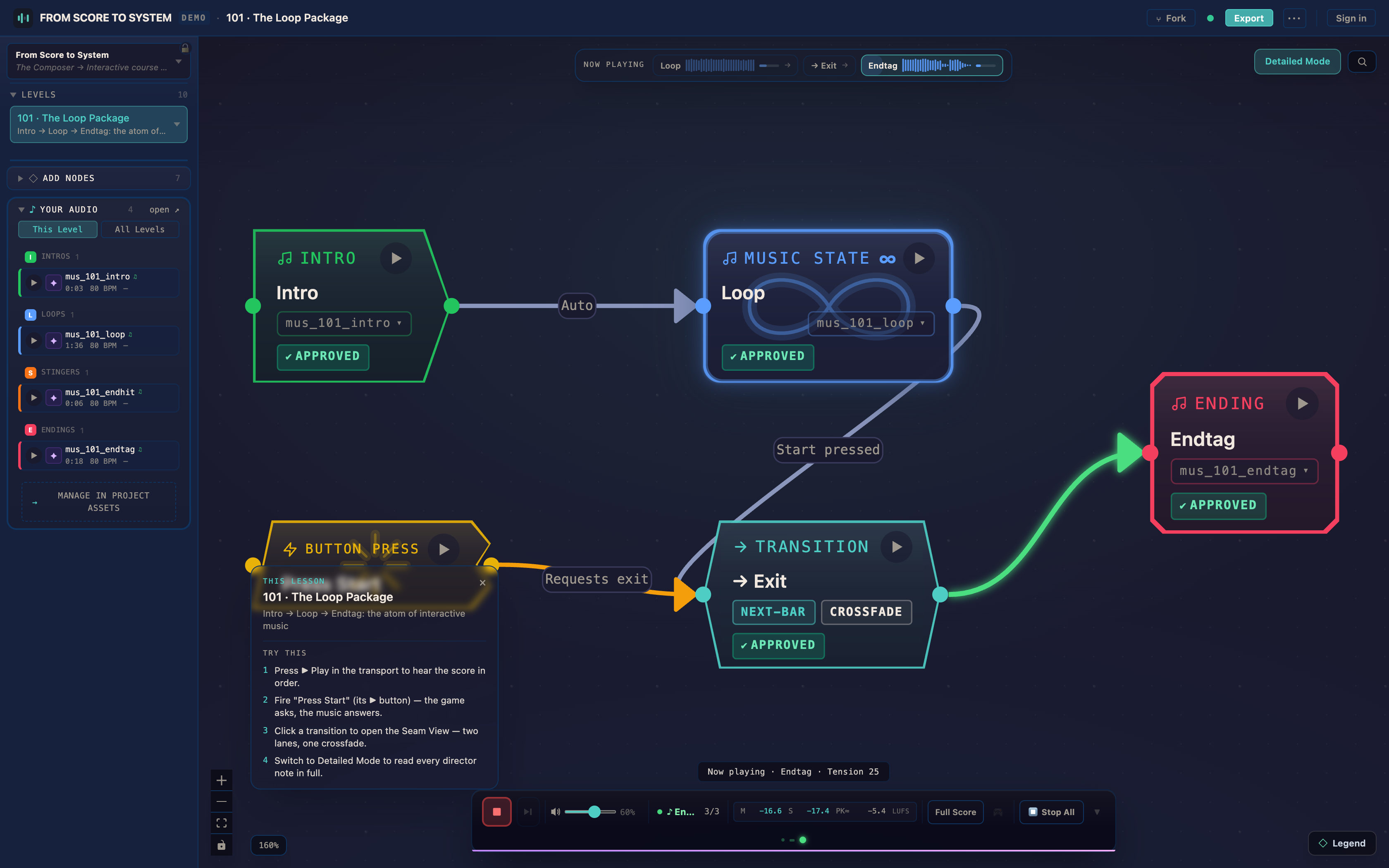
The design stance that makes this all tractable: the music never knows the future. It cannot know the player will enter combat in three seconds. Everything must sound composed anyway. That is why bar-line syncs, matched keys, and covering stingers exist — they are how music that is constantly interrupted keeps sounding like it meant to do that.
The idea: states are the map, transitions are the craft, and the music never knows the future.
Chapter 7Chunk-Based Systems
Loops hold time. Sometimes the game needs music that travels — a piece that moves forward with the player through a space, or fills an unknowable duration with music that never visibly repeats. The machine for that is the chunk system: the music written not as one long piece, but as a set of short, compatible building blocks — chunks — that the system chains together, in varying order, into a road of any length.
Think of it as writing the possibility of a piece rather than the piece. Each chunk is a phrase or two of music with an honest beginning and end. Any chunk can follow any chunk it's compatible with. The system deals them out, and the player hears a continuous composition that is different every time — assembled, like a card game where every legal hand is music.
The idea: write the possibility of the piece — short honest blocks plus the rules of what may follow what.
Chapter 8Layered Systems
▶ Stack and thin the layers yourself in Lesson 105 — then drive them with a parameter in 106.The last great machine changes music without changing pieces. A layered system writes one cue as a stack: a foundation that always plays, and layers above it — rhythm, urgency, melody, shimmer — that enter and leave as the situation changes. Danger rises: layers add. Danger passes: layers thin. The music intensifies without ever transitioning, because it was all one piece the whole time.
This is the machine behind the oldest magic trick in game music — the music that seems to know how the fight is going. It knows because someone connected it: the game continuously reports a number (tension, enemy count, health), and the number maps to the stack. That live wire — game value in, musical change out — is a parameter, and designing what it controls is some of the most rewarding work in the craft.
The compositional rule of stacks: every subset the system can produce is a mix somebody will hear. The foundation alone must satisfy — some player will hear it for an hour. The full stack must not be mud. And every combination between must sound like an arrangement, not an accident. Write each layer as if it might be soloed forever, because somewhere, for some player, it will be.
The idea: one piece, written as a stack — and every subset is a mix somebody will hear.
Chapter 9The Handoff
▶ Export a spec and walk the road to the engine in Lesson 108.Every design in this book eventually leaves home. The system you built and auditioned has to be rebuilt inside a game engine, by an implementer, in middleware like Wwise — and the measure of your design is brutal and fair: can a stranger build it without asking you anything?
The handoff is three things traveling together. The spec: the exported description of every state, transition, parameter, and rule — generated from the design everyone already heard, which is the whole reason it can be trusted. The assets: the stems and loops and stingers, cut exactly, named honestly, delivered to the standard where nobody emails you a question. And the audition trail: the shareable, playable design itself, so when the implementer wonders what you meant, they can hear what you meant.
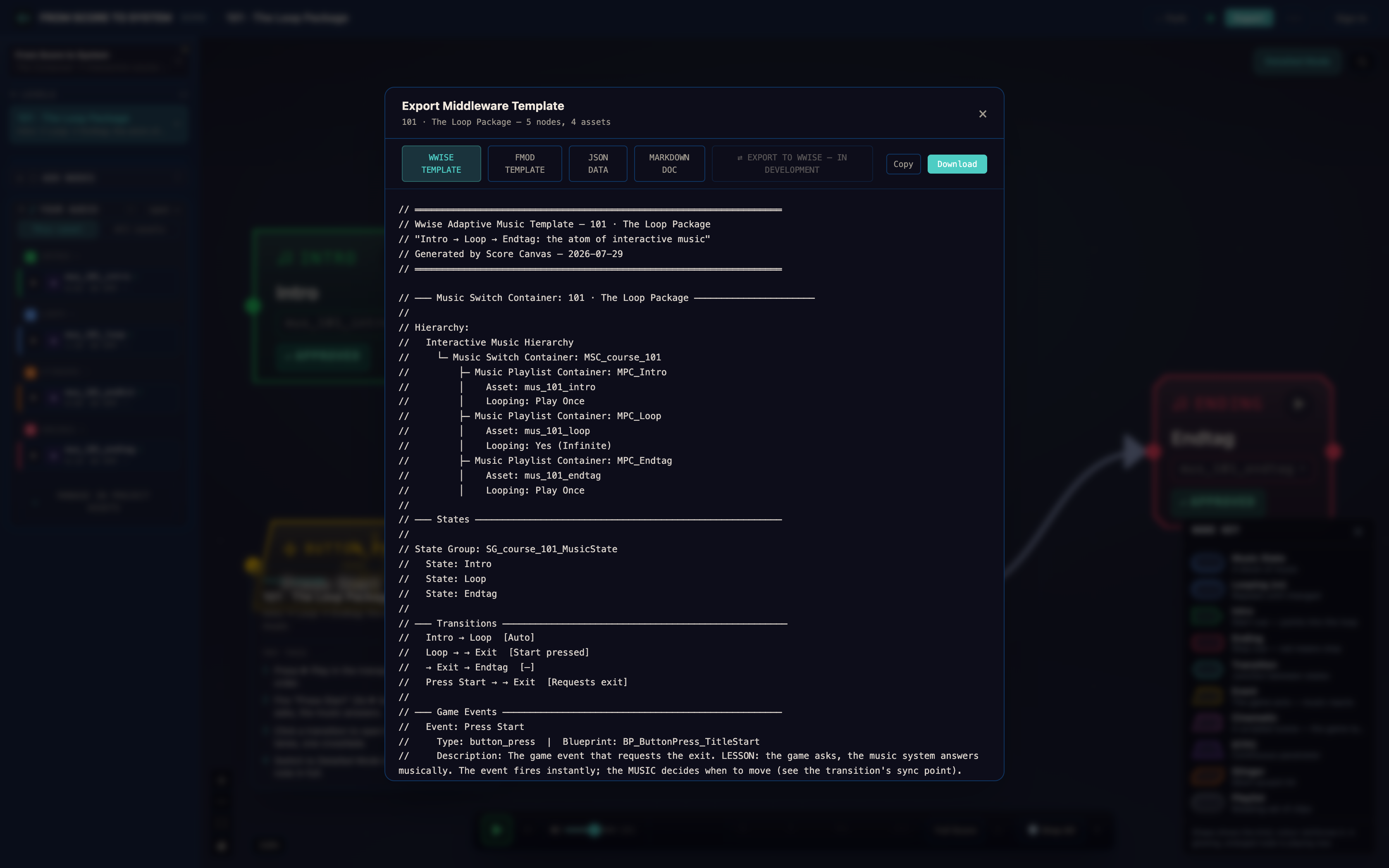
Then comes the part that keeps the craft honest: the implementer builds it, and you listen to the build. Not to your design — to the game. In-context, over gameplay, against gunfire and dialogue and rain. The system you hear there is the real one. Everything before it was rehearsal.
The idea: a design a stranger can build, assets nobody has to ask about, and the honesty to judge the build, not the rehearsal.
A Final NoteWhy This Book Exists
Here is something rarely said out loud in this field: the underlying architecture of interactive music has barely moved in thirty years. Fidelity has soared — better samples, better mixes, more voices, more channels. But the machines in this book — the loop, the state map, the layer stack, the parameter — would be recognizable to a practitioner from the era of cartridge consoles. We got better at everything except the shape of the thing itself.
That is not a complaint. It is an invitation. The next era of this craft is visible from here: music that doesn't live inside a three-minute artifact at all — music that lives with a person, across a day, responding to the world the way game music responds to a player, on whatever the screen becomes next. When that era arrives, it will belong to the people who think in systems — who design behavior, audition it, and hand a stranger something they can build.
Which is what this book just taught you to do. The tools will change. The shape of the craft is yours now.
Welcome to it.
The Curriculum
This book has a classroom life. Three complete course formats — a one-day workshop, a seven-week intensive, and a fifteen-week semester — teach this volume's systems on ScoreCanvas, with a shared workbook, rubrics, and instructor materials. All of it lives in Volume Three: The Teacher's Manual, written so an instructor who isn't the author can teach these ideas.
About the Author
Ted Kocher is an AAA Lead Music Designer with eighteen years and fifty-plus shipped titles, three Grammy-nominated scores, and five BAFTA wins. He teaches interactive audio at the graduate level and is the creator of ScoreCanvas (scorecanvas.io), the browser-based design surface for adaptive game music. This book was built independently under Back Pocket Music — personal time, personal equipment, no employer resources.
© 2026 Ted Kocher. All rights reserved.
Every check passed.
You've cleared the first mile of the instructor certification path. The rest happens with a human.
Start certification — book the session →